
Digital Equity in Chester County Starts With Trusted, Local Support
Adapted from reporting by Joan Holliday originally published in the Daily Local News on August 5, 2025, and June 2, 2026. The original articles, “Holliday: Kennett Community Digital Navigators are off to a good start” and “Holliday: The Welcoming Center partners with Adult Literacy Program on workforce development,” reported on digital literacy, workforce development, and digital inclusion efforts in the Kennett Square area. This adapted feature combines the two articles to illustrate the continuing need for investment in digital equity, digital skills, and trusted community-based support. Quotes from Joan Holliday’s original reporting and the people she interviewed are retained where indicated; additional statistics and context have been added by Connect-PA.
For some residents of the Kennett Square area, learning to use technology does not begin with complicated software or advanced computer skills.
It begins with learning how to turn on a computer.
It begins with learning how to move a mouse, scroll through a webpage, use a keyboard, create an email account, or join a Zoom call.
And increasingly, it begins with having someone nearby who can patiently help.
That is the role being filled by community digital navigators and adult literacy programs in the Kennett Square area, where local organizations have been working together to help residents build the skills and confidence they need to participate in an increasingly digital world.
The work offers a window into a broader digital equity challenge: having an internet connection is not enough if people do not have the skills, devices, confidence, language support, or trusted assistance necessary to use it.
Building digital skills one person at a time
In January 2025, two part-time digital navigators began working in the Kennett Square area through a program managed by RSVP.
The positions were made possible through financial support from the Longwood Foundation, the Aaron Martin Foundation and the Health and Welfare Foundation of Southern Chester County, in partnership with the Chester County Digital Alliance.
Juan Tafolla serves as a bilingual daytime digital navigator, while Nefta Erroa provides coverage during evenings and weekends. Together, their part-time schedules provide approximately 40 hours of coverage each week.
Their work is deliberately personal.
Digital navigators are trusted individuals who help people access and use digital resources, including internet service, devices and digital skills training. Rather than simply telling someone where to find information, navigators can sit beside them and work through the problem step by step.
That distinction matters.
For someone who has spent years without using a computer, a task that seems simple to an experienced internet user can become a significant barrier.
Jim Mercante, co-chair of the Chester County Digital Alliance, observed the first day of the program’s basic digital skills class.
“I was so impressed by the students desire to learn and the patience that Juan Tafolla showed in going from person to person to assist them in the basics,” Mercante said in Holliday’s original reporting.
He continued:
“We take for granted that everyone knows how to use the computer.”
But the class started at the very beginning.
“This first class was literally as basic as how to turn on the computer, use the mouse, scrolling and general keyboard/keys functions.”
For the students in the class, those foundational skills were not an academic exercise. They were a starting point for participating more fully in everyday life.
Over the following six weeks, students learned about cybersecurity, email, web browsing, apps and Zoom. At the end of the course, participants received a Chromebook and continued to receive tutoring based on their schedules.
The program illustrates why digital equity cannot be reduced to broadband deployment alone.
A household may have internet service available at its address, but that does not automatically mean every member of the household knows how to safely navigate the internet, communicate online, complete a job application, use telehealth, participate in a virtual meeting or protect personal information.
Pennsylvania’s Digital Equity Plan identifies digital skills and technical support, device access, affordability, and broadband availability as interconnected components of digital equity. The state’s plan emphasizes that meaningful participation in modern life requires more than simply having an internet connection.¹
National data show how widespread these challenges can be. The National Telecommunications and Information Administration’s Digital Nation Data Explorer found that **millions of Americans use the internet less than they would like because of barriers including affordability, lack of devices, lack of skills, or other limitations.**²
For communities trying to close the digital divide, that means the work cannot end once a broadband line reaches a home.
Someone may still need help learning how to use it.
The importance of trusted, local help
The Kennett Square digital navigator program was years in the making.
Michelle Hang, RSVP’s Digital Literacy Program Coordinator, described the effort as something that began as a long-term goal before becoming a reality through local investment and collaboration.
“What started as a dream in 2021 became an attainable goal for RSVP Volunteers thanks to the Kennett Area community funders and a partnership with the Chester County Digital Alliance.”
“A relationship was built and fostered, and the dream of direct help began in January of 2025 with two bilingual digital navigators in Kennett Square area.”
The navigators established regular hours at local community sites, including the Kennett Library and other partner organizations, where residents could receive assistance through scheduled programs or walk in for help.
They also work alongside Filomena Elliott, the Kennett Library’s bilingual program director. Elliott’s English-language classes provide another entry point for residents who are developing language skills and want to continue into basic digital literacy training.
That combination—language support, digital skills and trusted local relationships—is important in a community where residents have different levels of technological experience and different reasons for needing digital skills.
Tafolla, who is bilingual, sees the value of that one-on-one relationship firsthand.
“Digital navigators are an important job not just in the Kennett area but across the Commonwealth. Many people need help with the basic of how to use an I-Phone or Android phone or laptop.”
For him, the most rewarding part is not simply completing a lesson.
“For me, the best part of the job is when you get to help someone and see the expression on their face as they are exploring something new.”
And building awareness of the service is part of the work, too.
“It’s important to spread the word that Kennett has digital navigators here to help.”
That last point is easy to overlook.
A resource cannot help someone who does not know it exists—or who does not trust the organization providing it.
Seventy-five people, and counting
By August 2025, Hang reported that the digital navigators had already helped 75 individuals, with participation continuing to grow as awareness spread.
“So far, we have helped 75 individuals, and the numbers keep growing as word spreads, trust is built, and confidence is grown.”
Hang described the impact as extending beyond the number of people who walked through the door.
“The total impact is immeasurable as we see the daily goals achieved, and the hope and excitement in the communities’ eyes as we help them unlock doors and solve digital mysteries.”
That growth is one indication of why sustained investment matters.
Digital equity work is not necessarily a one-time intervention. A person may need help getting a device, then learning how to use it, then learning how to safely navigate online services, and later returning for help with a new task.
For older adults, the goals may be personal.
The digital navigator program planned to expand services to the Kennett Area Senior Center and Kendal Crosslands, beginning with cybersecurity and then working from each person’s individual goals.
One person may want to learn Zoom so they can see family members who live far away.
Another may want to use email.
Another may want to learn how to research information online.
The technology is the same, but the reason for learning it is deeply personal.
As the program’s approach recognizes, digital literacy works best when it starts with what a person wants to accomplish, rather than simply teaching a generic list of computer functions.
Digital skills are also workforce skills
The same principle appears in a second Kennett Square initiative reported by Holliday in June 2026.
The Kennett Library’s Adult Literacy Program partnered with The Welcoming Center, a Philadelphia-based nonprofit organization serving immigrants, to provide workforce development programming for immigrant residents in the Kennett Square area.
The partnership grew from a needs assessment.
Rather than arriving with a predetermined program, The Welcoming Center worked with the library to find out what local residents actually wanted.
Anuj Gupta, president and CEO of The Welcoming Center, explained:
“We want to do it in a way that adds value to the communities that we intend to serve. And we can’t prescribe that; we needed to get some real information on what they think they need.”
The result was a four-part workforce development model focused on English and digital skills, work readiness, entrepreneurship, and community leadership.
The first class, “English for Workplace Communication,” provided 60 hours of instruction over 12 weeks.
Twelve students completed the program.
For participants, the benefits went beyond vocabulary.
Christian, one of the students, said:
“I learned so many English words for the job environment and thought the classes were amazing.”
He also described gaining confidence through the experience. When he had to present a project about workforce benefits, he was nervous, but encouragement from his teachers and classmates helped him succeed.
Another student, Tomas, said the course helped him understand differences between his Mexican culture and American workplace practices.
“We acted out communications (role played) to see how to talk to each other better.”
He had lived in the Kennett area for four years.
“This was a whole new opportunity for me to get ahead.”
The next course, “English for Job Search,” was designed to go even further, teaching participants how to search for employment, prepare resumes and interviews, and better understand American workplace culture.
The class was planned for 80 hours over 14 weeks, with recruitment for up to 20 students.
Digital inclusion and economic opportunity are connected
The workforce program demonstrates another dimension of digital equity.
Today, finding a job increasingly means searching online, creating and submitting a resume electronically, communicating by email, completing online applications, participating in virtual interviews and navigating employer websites.
Pennsylvania’s Digital Equity Plan identifies employment and economic opportunity among the areas where digital access and skills are increasingly necessary. The plan specifically notes the role broadband can play in helping residents pursue employment, work remotely and participate in economic opportunities without having to leave their communities.³
For immigrants and other residents who are simultaneously learning English and navigating an unfamiliar workforce system, those barriers can compound.
Language skills and digital skills are not necessarily separate challenges.
A person may understand how to perform a job but struggle to complete an online application. They may have professional experience but lack confidence creating a digital resume. They may have a smartphone but not know how to use it to search for employment effectively.
That is why programs that combine language learning, digital skills and workforce development can address multiple barriers at once.
Gupta described the broader goal this way:
“The focus of our workforce model has always been one that by helping immigrants realize their full economic potential, we’re helping our entire community realize more economic opportunity through this project.”
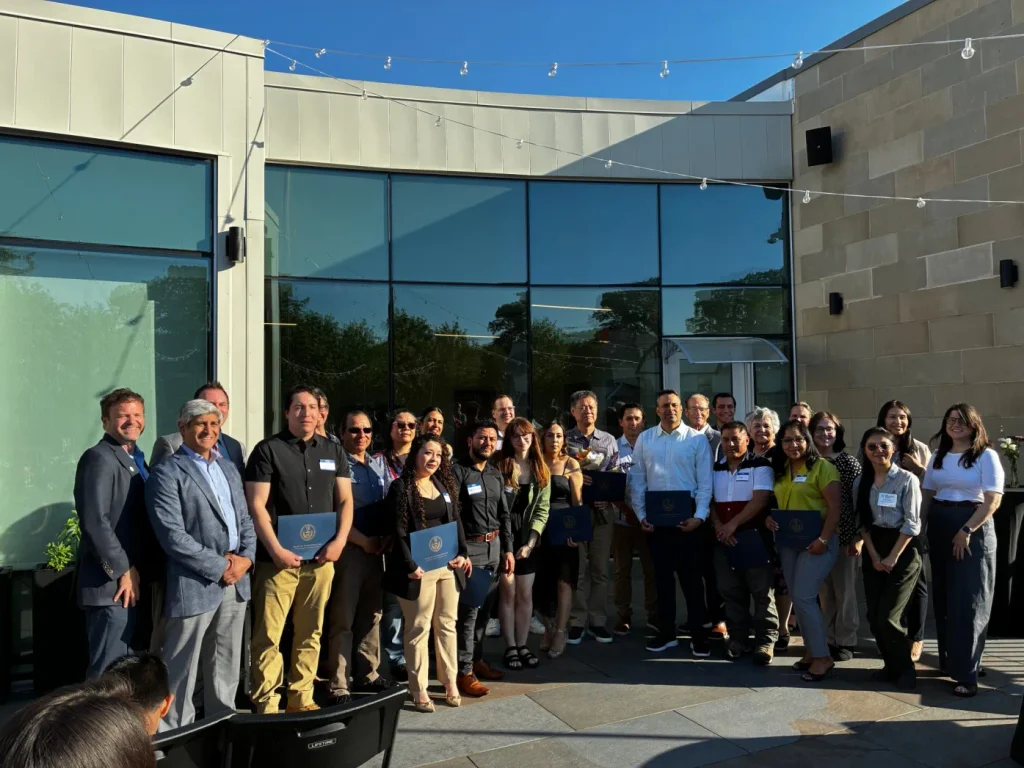
The Welcoming Center’s expansion into Kennett Square was supported by a $1 million grant from the Pennsylvania Legislature, which Gupta said helped make it possible to replicate the organization’s model outside Philadelphia.⁴
For Kennett Square, that investment brought a program designed around the needs identified by local residents.
Education becomes a community investment
At the May 29, 2026, celebration marking completion of the first workforce development class, students received certificates recognizing their work.
Kennett Library Executive Director Chris Manna told participants:
“Education is hope. Learning is life-long.”
Filomena Elliott, director of the Kennett Library Adult Literacy Program, similarly described the partnership as an investment that extends beyond individual students.
“I look forward to expanding the partnership with The Welcoming Center as we continue to give the participants skills to be able to succeed in the workforce.”
She added:
“This workforce development program demonstrates that education becomes a win-win not only for the students but for the whole community.”
That idea is at the heart of digital equity.
The benefit of teaching one person how to use email is not limited to that individual.
The benefit of helping one senior learn Zoom may be the ability to maintain relationships with family members who live hundreds of miles away.
The benefit of helping an immigrant worker build digital and English-language skills may extend to their employment, income and ability to contribute to the local economy.
The benefit of teaching someone cybersecurity may be protection against a scam or identity theft.
And the benefit of helping a student or job seeker access a computer may be a new educational or employment opportunity.
Digital equity is therefore not simply about technology.
It is about what people can do once technology becomes accessible to them.
Why investment has to continue
The Kennett Square programs also demonstrate something important about digital inclusion work: community infrastructure takes time to build.
RSVP’s digital navigator program began as an idea in 2021 before becoming a staffed service in 2025.
The Welcoming Center’s expansion to Kennett Square began with a local needs assessment before classes were designed.
The programs rely on libraries, nonprofit organizations, funders, volunteers, educators and community leaders working together.
That kind of infrastructure is difficult to create through a one-time distribution of devices or a broadband construction project alone.
Pennsylvania’s Digital Equity Plan recognizes the importance of community-based organizations and trusted institutions in helping residents overcome digital barriers.⁵ Libraries, senior centers, schools, workforce organizations and other community institutions can serve as places where residents not only access the internet, but receive the human support necessary to use it effectively.
The Kennett Square experience offers a practical example of what that can look like.
A bilingual navigator meets someone where they are.
A library provides a trusted place to learn.
A teacher connects language learning to digital skills.
A funder provides the resources necessary to sustain the program.
A volunteer or community organization helps spread the word.
And a resident who once struggled to turn on a computer begins using it to communicate with family, find a job, attend a class or navigate an online service.
That is the work of digital inclusion.
It is also why the need does not disappear simply because broadband infrastructure improves.
As more education, healthcare, employment, government services and social connection move online, the consequences of being unable to participate grow.
The question is no longer simply who has internet?
It is who can use it, who can afford it, who has a device, who feels confident using it, who can use it safely, and who has someone to turn to when they need help?
The work underway in the Kennett Square area suggests one answer: trusted community support can help turn access into opportunity.
And the people doing that work are showing that digital equity is not an abstract goal.
It can begin with something as simple—and as important—as sitting beside someone and teaching them how to turn on a computer.
Notes
- Pennsylvania Broadband Development Authority, Connected and Empowered: A Digital Equity Plan for the Commonwealth of Pennsylvania (Harrisburg: Pennsylvania Broadband Development Authority, February 13, 2025), https://broadband.pa.gov/wp-content/uploads/2025/02/DigitalEquityPlan_02-13-2025Final.pdf. The Commonwealth’s digital equity plan identifies broadband availability, affordability, device access, digital skills, and technical support as interconnected components of digital equity. (broadband.pa.gov)
- National Telecommunications and Information Administration, “Digital Nation Data Explorer,” U.S. Department of Commerce, accessed September 2, 2026, https://www.ntia.gov/data/digital-nation-data-explorer. NTIA’s data examine barriers to internet adoption and use, including affordability, device access and digital skills. (ntia.gov)
- Pennsylvania Broadband Development Authority, Connected and Empowered: A Digital Equity Plan for the Commonwealth of Pennsylvania. The plan identifies employment, workforce development and economic opportunity as areas affected by broadband access and digital skills. (broadband.pa.gov)
- Joan Holliday, “Holliday: The Welcoming Center partners with Adult Literacy Program on workforce development,” Daily Local News, June 2, 2026. Holliday reported that The Welcoming Center received a $1 million grant from the Pennsylvania Legislature and that Kennett Square became its first Pennsylvania outreach location.
- Pennsylvania Broadband Development Authority, Connected and Empowered: A Digital Equity Plan for the Commonwealth of Pennsylvania. The plan emphasizes the role of community organizations and trusted institutions in addressing digital inequities and reaching populations experiencing barriers to broadband adoption and use. (broadband.pa.gov)
Original reporting sources
Joan Holliday, “Holliday: Kennett Community Digital Navigators are off to a good start,” Daily Local News, August 5, 2025. Originally published August 5, 2025, and updated August 5, 2025. The article reported on RSVP’s Kennett Square digital navigator program, local philanthropic funding, the first digital literacy class, the role of the Chester County Digital Alliance, and the program’s work with seniors and bilingual residents.
Joan Holliday, “Holliday: The Welcoming Center partners with Adult Literacy Program on workforce development,” Daily Local News, June 2, 2026. Originally published June 2, 2026. The article reported on the partnership between The Welcoming Center and the Kennett Library Adult Literacy Program, the workforce development classes, student experiences, and the program’s expansion into the Kennett Square area.
This feature is an adaptation, not original reporting. The core narrative, quotations, program descriptions and participant experiences are drawn from Joan Holliday’s original reporting for the Daily Local News. The two original articles have been combined and reorganized into a single digital inclusion feature, with additional Pennsylvania digital equity statistics and context added to connect the local experiences to the broader need for sustained digital equity investment.